
How many sewing pattern testers do you need?
The number of sewing pattern testers you need depends on the sizes, views and construction paths you want to check, not just the total people who apply. Start with a size-and-view grid and assign a planned make to each combination you need evidence for. Two testers per size is one designer’s published approach, but it isn't a universal rule or a guarantee of fit; count completed reports against your plan before calling the round finished.
How many sewing pattern testers do you need per size?
Choose a target per size based on what each make will tell you. One completed make gives you one set of observations under that tester’s fabric, body and alteration conditions. A second make can provide another perspective or cover a different view, but two different views don't give you two independent checks of the same construction.
The Cajun Girl’s testing guidelines say the designer usually chooses two testers per size. In the Folds describes selecting testers from a spreadsheet, checking that there were at least two candidates for each size and using view preferences to fill gaps. These are examples of designers’ practices, not evidence that every pattern needs the same number.
Use those examples as a starting point for planning. If you choose two completed makes per size for six sizes, your target is 12 makes. If you need two makes of each of two views in all six sizes, your target becomes 24. That is a count of garments and reports, not necessarily people: agree explicitly if one tester is willing to make more than one garment.
List the coverage you need before accepting testers
Put the pattern’s exact size labels down the rows and its views across the columns. Add a separate note for any construction option that needs its own check, such as an optional closure that changes the assembly steps.
For each planned make, record:
- Size and view, using the pattern’s own labels.
- Test file version and any later version used for a recheck.
- Relevant fabric requirements and intended alterations.
- Tester reference, agreed make and current status.
- The report or evidence received, plus any follow-up needed.
Select against the empty cells rather than taking applications in arrival order. Five people making the same size and view may provide useful detail there, but they don't supply evidence for an unmade size.
Include makers whose experience matches the intended customer. In the Folds describes using varied sewing skills because different makers notice different things, while excluding beginners from a test of a pattern that wasn't designed for them. For your round, ask about experience with the actual techniques instead of choosing only your most advanced repeat testers.
Example: 12 planned makes leave two coverage gaps
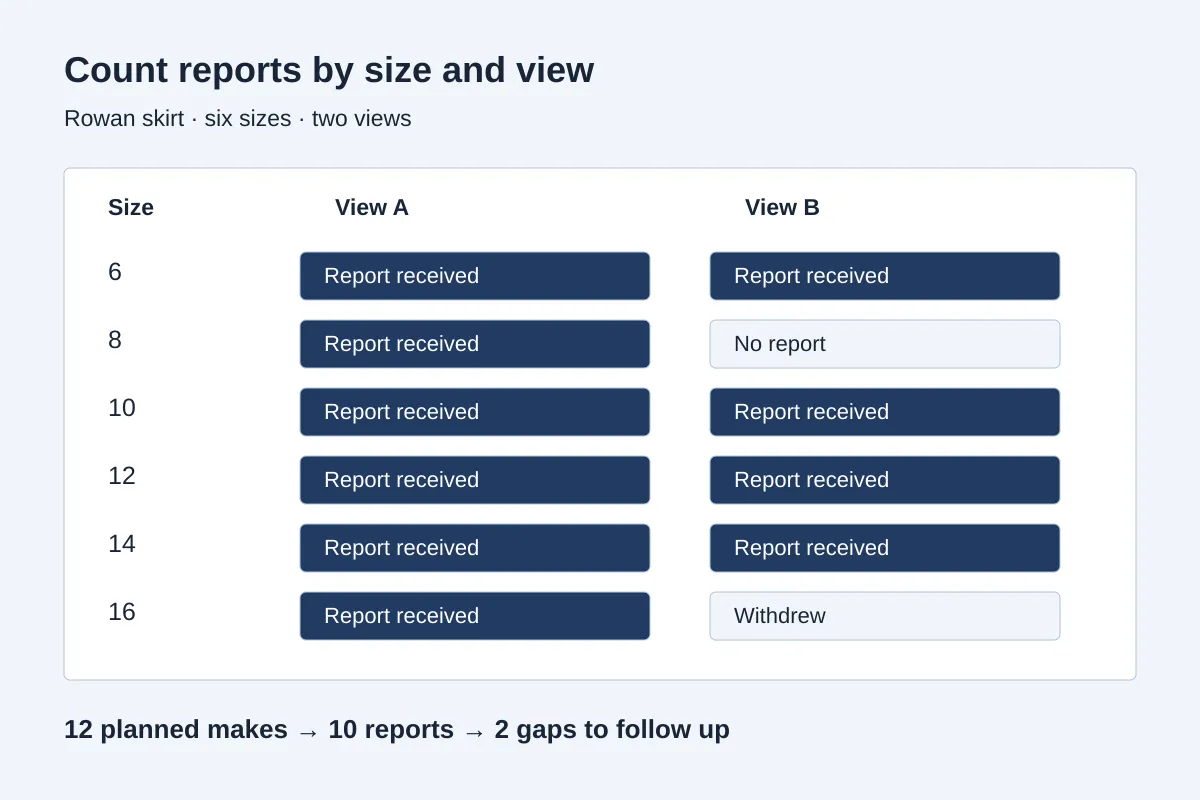
Say you're testing a Rowan skirt in sizes 6, 8, 10, 12, 14 and 16. View A has a plain front; view B adds a button-front construction. You decide to seek one completed make of each view in each size: six sizes multiplied by two views gives 12 planned makes.
You assign 12 testers, one garment each. At review time, every view A report is in, but the size-8 view B tester hasn't submitted a report and the size-16 view B tester has withdrawn.
| Coverage at review | Count | What it tells you |
|---|---|---|
| Planned makes | 12 | Each size-and-view cell had an assignment |
| Reports received | 10 | Ten cells now have reports to review |
| Sizes with at least one report | 6 | Every size has some evidence, but not both views |
| View B gaps | 2 | Sizes 8 and 16 still need follow-up |
The right next action is to ask the size-8 tester whether a report is still possible and seek an agreed replacement or targeted check for size 16 view B. Recruiting another size-12 view A tester won't fill either gap.
A report received isn't automatically a successful check. If one of the ten reports describes a blocking problem, retain the report as evidence and track the correction and recheck separately. The coverage grid answers “what was tested?”; the correction list answers “what still needs changing?”
Allow for unfinished makes without guessing a dropout rate
Keep “assigned,” “started,” “report received,” “couldn't continue” and “withdrew” distinct. An accepted invitation tells you someone intends to test; it doesn't tell you that you have a finished garment or usable review evidence.
If you have records from comparable past rounds, use them to decide where an additional willing tester would be useful. For a first round, don't turn an assumed completion percentage into a precise recruitment promise. Keep a gap list and arrange a check-in before the final deadline so you can respond while there's still time.
Ask why a make stopped. A missing instruction is a reported issue worth reviewing even without a finished garment. Running out of time is a coverage gap, but isn't evidence of a pattern fault. Don't silently change a tester’s assignment or expect extra garments without agreement.
Record what a graded or altered make actually checks
A tester who blends sizes provides useful evidence, but their garment shouldn't be counted as an unaltered make of every size it touches. Record the size at each relevant area and the changes made. Keep the original size choice and the alteration amounts with the report so you can interpret fit observations in context.
Likewise, a successful garment in one fabric doesn't tell you how every permitted fabric will behave. Decide which fabric differences matter to your pattern’s recommendations and seek checks for those conditions. You don't need to test every possible combination to make a useful plan, but you do need to name the combinations you left out.
Before release, review gaps alongside unresolved issues and your own pattern checks. A small tester group cannot establish that a garment fits every body; avoid letting a full-looking grid stand in for reviewing the actual evidence.
Give every planned make a report you can use
Once assignments are clear, use these sewing pattern tester feedback form questions to capture the file, size, alterations and step-specific observations. When reports arrive, organize tester feedback into a correction list while preserving the link to each source.
Seam Signal’s free tester-question sheet lets you enter your pattern’s sizes and step labels, edit the generated questions, and copy or download them into your existing form or document without signup. The sheet stays in your browser; it doesn't recruit testers or collect their responses.