
Sewing pattern tester feedback form: questions to ask
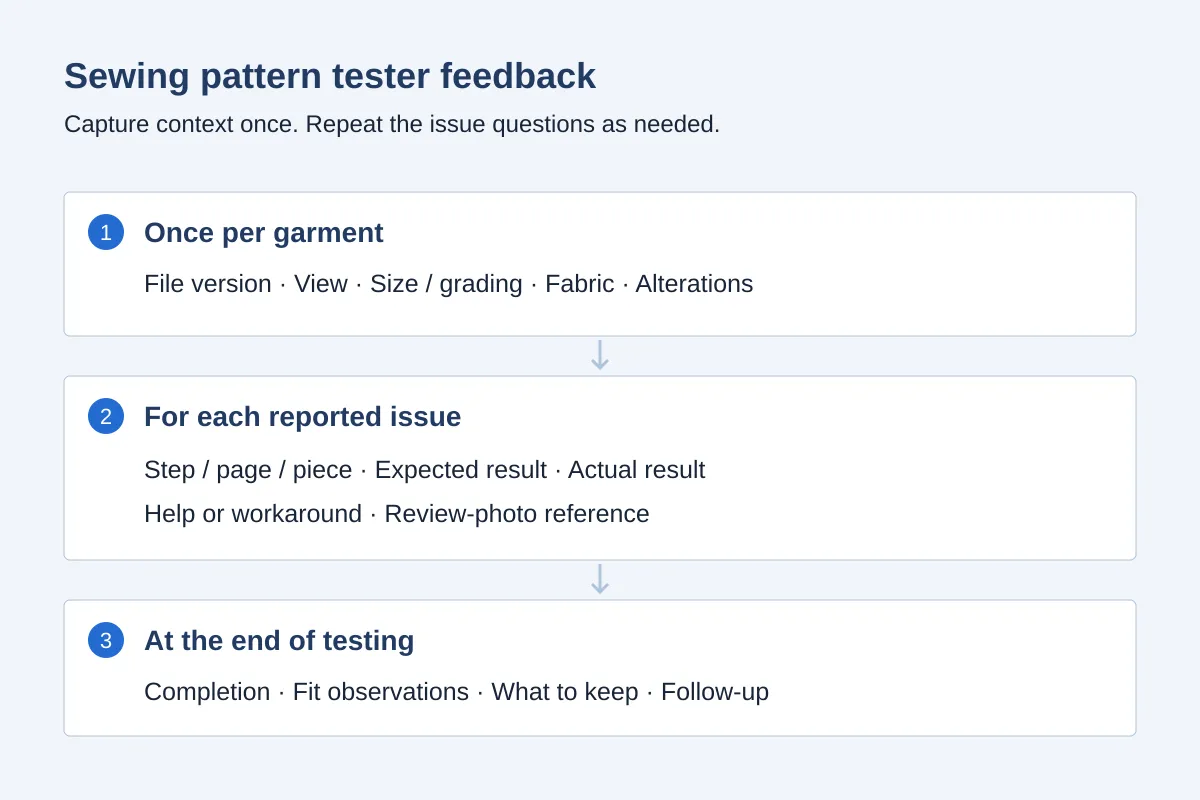
Sewing pattern tester feedback form questions should capture the tested file, size, fabric and alterations, then ask where an issue occurred, what the tester expected and what happened. Collect garment context once and repeat a short issue section for each problem. Finish with questions about fit, completion and what worked well, so successful parts of the pattern are recorded too.
Which sewing pattern tester feedback form questions help?
Ask questions that locate an observation and explain the conditions behind it. A final satisfaction score can summarize a tester’s experience, but it won't tell you which instruction or pattern piece to review.
In the Folds shares end-of-test questions about modifications, likes and dislikes about fit, and steps needing more detail. It also uses a section-by-section shared document for general notes. The form below builds on those subjects with location and follow-up prompts; it's a suggested structure you can copy into your own form or document.
Preparing your test? Build a tester-question sheet from your own pattern setup, then review, copy or download questions using your exact sizes and step labels for your existing form or document. No signup needed; the sheet does not collect tester responses.
Ask for garment context once
Put these questions at the start. If someone tests two views or different file versions, give each garment a separate response so its context stays clear.
- Which pattern, view and file version did you sew? Show where to find the version label. Include “version not recorded” rather than making the tester guess.
- Which size did you choose, and did you grade between sizes? Ask for the size at each graded area and which size-chart measurements informed the choice. State the measurement units you need. Avoid collecting unrelated personal details.
- What fabric did you use? Ask for fabric type and composition if known. Add a stretch question for a stretch pattern, or weight and drape questions if those are relevant to your fabric recommendations. Allow “not known.”
- What did you change before cutting or during sewing? Ask for the piece or garment area, the adjustment and its amount. Distinguish “no changes” from “not recorded.”
Record sewing experience with the relevant technique if it helps interpret the test: “Had you sewn a welt pocket before?” is more specific than a compulsory beginner-to-expert rating.
Repeat these questions for each reported issue
Let testers report an issue while it is fresh, without waiting to finish the garment. Use a repeatable block in a document, or a separate issue form linked to the garment response. Include an explicit “no issue to report” route.
- Where did this happen? Ask for the step, page, diagram or pattern-piece label. Offer “general fit” and “location not known” when a numbered instruction isn't the right reference.
- What did you expect to do or see, and what happened instead? Use two answer boxes. Keep the tester’s description in their own words; don't require a diagnosis such as “drafting error.”
- Did you need help or use a workaround? Ask what they tried, whether someone clarified the step, and whether they followed a different technique. Include “I could not continue.”
- Is there a photo that helps explain the observation? Request only the view needed for review and ask the tester to identify the step or garment area it shows. Provide a way to explain the issue in words if a useful photo isn't available.
Explain who will see review photos and how testers should send them. Ask separately for any permission to publish a photo; submitting fit evidence shouldn't silently become consent to marketing use. Closet Core describes distinguishing fit-review photos from optional, permission-based sharing after launch.
Example: turn “the pocket was confusing” into a useful response
Say a tester is sewing view B, size 16, from test file v2. They've used the recommended fabric type and haven't altered the pocket. Your issue questions might produce this response:
- Location: Step 14, page 9, patch-pocket diagram.
- Expected: “I expected the diagram to show which edge to finish before attaching the pocket.”
- Observed: “The highlighted edge wasn't labelled, so I couldn't tell whether it meant the opening or the sides.”
- Help or workaround: “I asked in the testing group and finished both edges after getting an answer.”
- Evidence: A construction photo showing the pocket before attachment, supplied for review.
That response identifies an instruction to inspect and records the extra help. A checkbox saying “pocket completed” would miss the uncertainty. The designer can now compare the wording and diagram with the intended construction before choosing a change.
Avoid asking “Was step 14 clear and easy?” Clear wording and easy construction are different questions, and the phrasing invites a positive answer. “Where did you pause or need clarification?” leaves room for a specific difficulty.
Finish with fit, completion and what to keep
These questions belong at the end of the test, including when a tester couldn't finish:
- How far did you get, and what stopped you if the garment is incomplete? Separate a pattern-related obstacle from lack of time, supplies or another reason.
- How does the garment fit compared with the pattern’s described fit? Ask which area they mean, what they notice while wearing or moving in it, and whether the observation was before or after alterations. Give personal style preferences their own space instead of treating every preference as a sizing fault.
- Which instructions or features worked well and should stay? Ask for a step or feature where possible. This helps you avoid rewriting useful explanations merely because other sections need work.
- What is the most important thing for the designer to review, and may we follow up? Keep a final open-comment box. Use a tester reference and your agreed contact route rather than asking for contact details in every issue report.
Test the form before sending it
Fill it out using one trial observation. Can you tell which file, size and location the note concerns? Can someone who didn't finish still submit? Can a tester report two separate issues without mixing their answers?
Make identifying context required where you genuinely need it, with explicit unknown options. Keep optional photos and irrelevant technical details from blocking a response. Route questions about a particular technique only to testers who used it.
Once responses arrive, keep the raw answers and designer decisions separate. Use the next guide to organize sewing pattern tester feedback into a correction list.
To try that handoff with one note, Seam Signal’s signup-free correction exercise lets you enter an anonymised observation, write a linked size- and step-specific decision, and copy or download it for your checklist. Work stays in this browser by default, so remove personal or sensitive details; the exercise doesn't collect responses from invited testers.